
August 2025

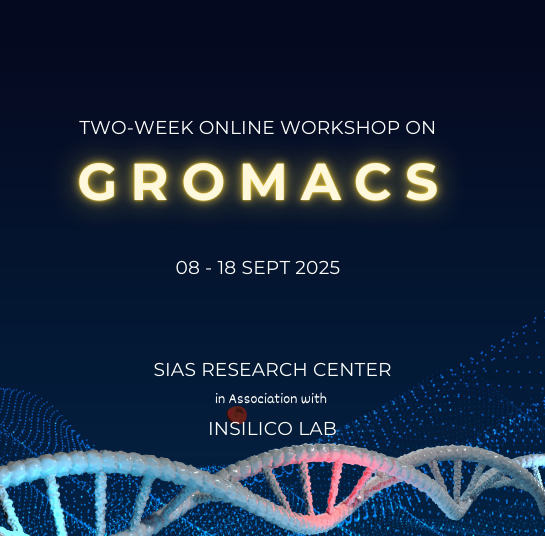
Two-Week Online Workshop on GROMACS

Two Week Online Workshop on GROMACS Introduction to Molecular Dynamics Simulation 08 – 18 September 2025 Live out your life. Welcome to the Greatest Conference 2025 Thousands of WordPress themes to start your new website withings a bang. Beautiful templates for the world’s most popular content man age ement of our system controll. Learn More speakers Event Speakers Meet our speakers. We’re adding more every week. Jack Henry Microsoft Office lead Speaker event@speaker.com Jack Henry Microsoft Office lead Speaker A small river named Duden flows by their place and supplies it with the necessary Phone:+1 (859) 254-6589 Email:info@example.com James William Google Office lead Speaker event@speaker.com James William Google Office lead Speaker A small river named Duden flows by their place and supplies it with the necessary Phone:+1 (859) 254-6589 Email:info@example.com Grace Amelia Apple Office lead Speaker event@speaker.com Grace Amelia Apple Office lead Speaker A small river named Duden flows by their place and supplies it with the necessary Phone:+1 (859) 254-6589 Email:info@example.com Schedule Event Schedule A small river named Duden flows by their place and supplies. 9.30 – 10.30 AM Marketing Matters! A small river named Duden flows by their place and supplies it with the necessary regelialia. It is a paradise Alan Hudsun Designer @ Main hall 10.30 – 12.30 AM Reinventing Experiences A small river named Duden flows by their place and supplies it with the necessary regelialia. It is a paradise Joe Rot Co-founder @ Main hall 9.30 – 10.30 PM Cultures of Creativity A small river named Duden flows by their place and supplies it with the necessary regelialia. It is a paradise Stive Smith Founders Nest @ Main hall 11.30 – 12.30 PM Human Centered Design A small river named Duden flows by their place and supplies it with the necessary regelialia. It is a paradise James Killer CEO of Team expert Discover Event Ticket Price Explore Pricing Policies Single day pass $ 150 One catered lunch Afternoon snacks Fun swag Entrance Afterparty Get Ticket Single day pass $ 250 Fun swag Afternoon snacks One catered lunch Entrance Afterparty Talking the Editors Session Available tickets for this price One Day Conference Ticket Get Ticket All day pass $ 450 Unlimited Entrance Afternoon snacks One catered lunch Fun swag Get Ticket NB: Price is in US dollars. The price displayed excludes sales tax. News News and Blogs Latest From Newsroom Venue How to reach Direction to the Venue REACH US Get Direction the Event Hall Street 140 Avenue, NY 90001 USA Get Directions inn eindhoven hotel Elements users get 30 days of free access professional images sponsor. Hotel Website

Two-Week Online Workshop on GROMACS Read More »

Understanding the interaction mechanisms of antimicrobial peptides and bacterial membrane

Project Code CHY2502 Computational Chemistry Molecular Dynamics Molecular Dynamics MD Understanding the interaction mechanisms of antimicrobial peptides and bacterial membrane Computational Chemistry Started from August 16, 2025 Abstract Excess usage of antibiotics worldwide has led to the formation of many multi-drug-resistant strains of some of the most dangerous pathogens. This has created an urgency for the development of the replacement of antibiotic molecules. Antimicrobial peptides are molecules with long and short amino acid sequences that can be deployed to resist bacterial activities. The AMPs adsorb on bacterial cell-membrane and damage the membrane leading to the disintegration and rupture of the cell-membrane. The mechanism of AMP and cell-membrane interactions has long been studied experimentally and computationally. However, a general mechanism has not been proposed. In this project, we will be using state-of-the-art AMP database such as, dAMP, lAMP, etc., to choose AMP candidates based on their antimicrobial capabilities, design their 3D structure computationally and use atomistic and coarse-grain molecular dynamics simulations to study interactions between AMP candidates and model bacterial membrane structure.  Objectives To computationally model and analyze how antimicrobial peptides (AMPs) interact with and disrupt bacterial cell membranes using molecular dynamics simulations in GROMACS, thereby elucidating the mechanisms underpinning their antimicrobial action. Expected Outcomes Quantify how AMPs associate with, insert into, or deform bacterial membranes (e.g., binding depth, orientation, insertion angle). Identify and characterize key interaction pathways and modes of action—e.g., whether peptides induce pore formation, act via carpet-like mechanisms, or cause localized thinning Assess free energy changes over the simulation, possibly via PMF (Potential of Mean Force) calculations or related methods. Team Dr. Bibhab Bandhu Majumdar PI, VIT-AP University Ms. Nandhini Project Fellow 16,864 Unit Used Goal 120,000 75% Give Children a Safer and Happier Childhood Charity 5 days rem. Research Projects Understanding the interaction mechanisms of antimicrobial peptides and bacterial membrane DFT Investigation on Excited-State Proton Transfer Mechanisms for Advanced Chemosensing Applications Research Field Computational Chemistry Computational Physics Computational Biology Computational Material Science Data Science

Understanding the interaction mechanisms of antimicrobial peptides and bacterial membrane Read More »

Understanding the interaction mechanisms of antimicrobial peptides and bacterial membrane

Project Code CHY2502 Computational Chemistry Molecular Dynamics Molecular Dynamics MD Understanding the interaction mechanisms of antimicrobial peptides and bacterial membrane Computational Chemistry Started from August 16, 2025 Abstract Excess usage of antibiotics worldwide has led to the formation of many multi-drug-resistant strains of some of the most dangerous pathogens. This has created an urgency for the development of the replacement of antibiotic molecules. Antimicrobial peptides are molecules with long and short amino acid sequences that can be deployed to resist bacterial activities. The AMPs adsorb on bacterial cell-membrane and damage the membrane leading to the disintegration and rupture of the cell-membrane. The mechanism of AMP and cell-membrane interactions has long been studied experimentally and computationally. However, a general mechanism has not been proposed. In this project, we will be using state-of-the-art AMP database such as, dAMP, lAMP, etc., to choose AMP candidates based on their antimicrobial capabilities, design their 3D structure computationally and use atomistic and coarse-grain molecular dynamics simulations to study interactions between AMP candidates and model bacterial membrane structure.  Objectives To computationally model and analyze how antimicrobial peptides (AMPs) interact with and disrupt bacterial cell membranes using molecular dynamics simulations in GROMACS, thereby elucidating the mechanisms underpinning their antimicrobial action. Expected Outcomes Quantify how AMPs associate with, insert into, or deform bacterial membranes (e.g., binding depth, orientation, insertion angle). Identify and characterize key interaction pathways and modes of action—e.g., whether peptides induce pore formation, act via carpet-like mechanisms, or cause localized thinning Assess free energy changes over the simulation, possibly via PMF (Potential of Mean Force) calculations or related methods. Team Dr. Bibhab Bandhu Majumdar PI, VIT-AP University Ms. Nandhini Project Fellow 16,864 Unit Used Goal 120,000 75% Give Children a Safer and Happier Childhood Charity 5 days rem. Research Projects Understanding the interaction mechanisms of antimicrobial peptides and bacterial membrane DFT Investigation on Excited-State Proton Transfer Mechanisms for Advanced Chemosensing Applications Research Field Computational Chemistry Computational Physics Computational Biology Computational Material Science Data Science

Understanding the interaction mechanisms of antimicrobial peptides and bacterial membrane Read More »

DFT Investigation on Excited-State Proton Transfer Mechanisms for Advanced Chemosensing Applications

Project Code CHY2501 Computational Chemistry DFT Quantum Chemistry DFT DFT Investigation on Excited-State Proton Transfer Mechanisms for Advanced Chemosensing Applications Computational Chemistry Started from August 16, 2025 Abstract Excited-state proton transfer (ESPT) is a fundamental photophysical process that underpins the fluorescence behavior of many organic and organometallic molecules. In chemosensing, ESPT provides a highly selective and sensitive pathway for detecting target analytes through distinct optical responses. This project investigates the ESPT mechanism in newly designed thiosemicarbazone- and pincer-ligand-based receptors, focusing on their interactions with environmentally and biologically relevant ions such as fluoride, cyanide, and hydroxide. The study integrates experimental spectroscopy (UV–Vis, fluorescence, NMR titrations) with advanced computational methods (DFT, TD-DFT, PES, NBO, and transition state analyses) to unravel the electronic and structural factors governing ESPT. The outcomes of this work are expected to guide the rational design of next-generation chemosensors with enhanced selectivity, sensitivity, and real-world applicability in environmental monitoring and biomedical diagnostics. Objectives Computational Studies employing DFT/TD-DFT to model electronic transitions, proton transfer coordinates, and energy landscapes. Mechanistic Elucidation of ESPT, including identification of transition states, excited-state proton dynamics, and charge transfer interactions. Application Development of ESPT-based chemosensors for selective detection of toxic ions and analytes in environmental and biological samples. Expected Outcomes Mechanistic Insight: A detailed understanding of ESPT pathways in chemosensing molecules. Mechanistic Insight: A detailed understanding of ESPT pathways in chemosensing molecules. Novel Chemosensors with improved optical response, capable of selectively detecting ions such as F⁻, CN⁻, and OH⁻ Team Dr. Sabeel M Basheer PI, VIT-AP University Ms. Nandhini Project Fellow 16,864 Unit Used Goal 120,000 75% Give Children a Safer and Happier Childhood Charity 5 days rem. Research Projects Project24 DFT Investigation on Excited-State Proton Transfer Mechanisms for Advanced Chemosensing Applications DFT-Guided Investigation of CO₂ Reduction Mechanisms on Novel Perovskite Catalysts Research Field Computational Chemistry Computational Physics Computational Biology Computational Material Science Data Science

DFT Investigation on Excited-State Proton Transfer Mechanisms for Advanced Chemosensing Applications Read More »